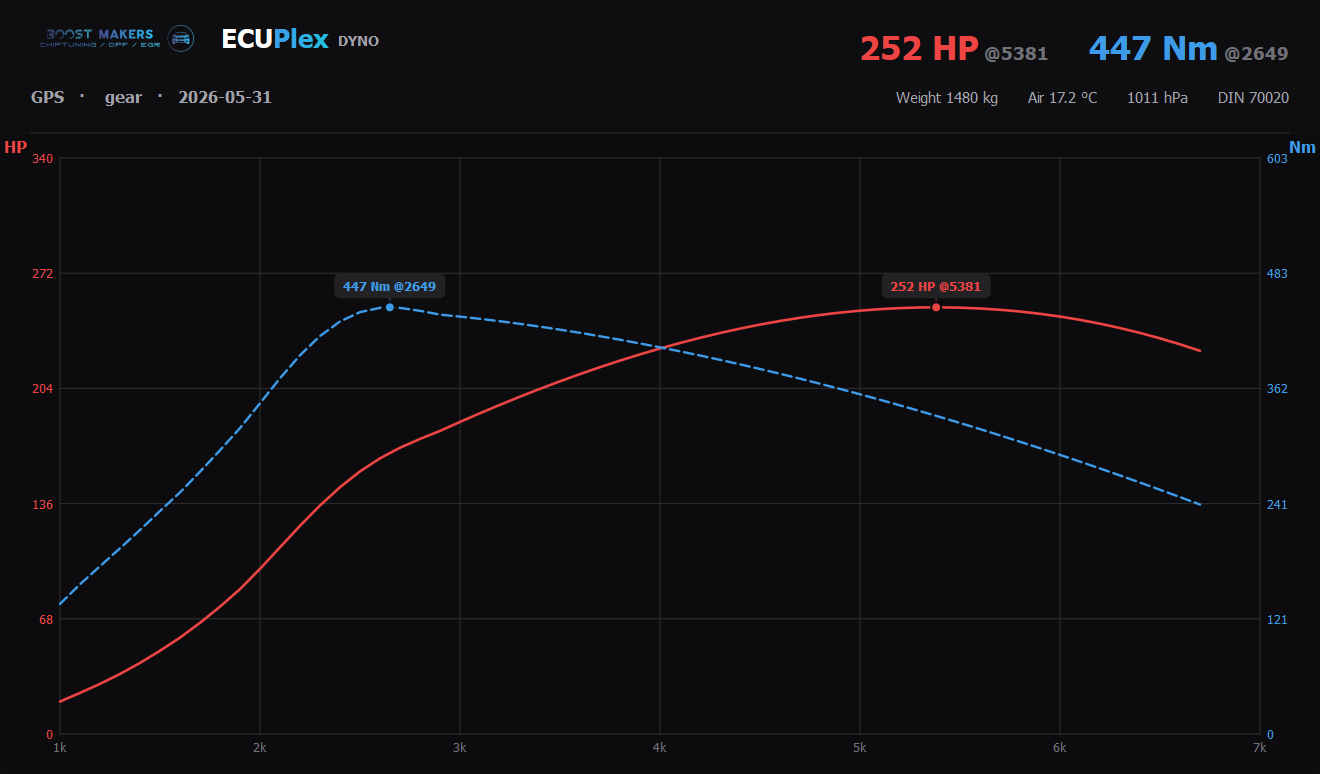
One of the most-requested tools in the ECUPlex ecosystem just went live: ECUPlex Dyno. It turns any stretch of road into a full dyno bench — no rollers, no straps, no half-day trip across town to book someone else's equipment. Just a laptop, a GPS receiver, and the road you already know.
Road dynos aren't a new idea. We spent a long time working with the tools already on the market before starting this project, and each of them had something that stopped it from becoming the shop's daily driver — clunky OBD dependencies, results we didn't fully trust, closed ecosystems we didn't want to build a workflow around. Eventually the answer became obvious: build the one we actually wanted to use ourselves. ECUPlex Dyno is that tool.
What ECUPlex Dyno actually is
ECUPlex Dyno is a GPS-based road dyno for Windows. Plug a 10 Hz USB GPS receiver into your laptop, do a one-time speed-to-RPM calibration on the vehicle, and you're ready to measure. Every run follows the same simple flow: hold steady speed, go full throttle to redline under the app's live guidance, clutch in, and coast down. That single pull is the whole test.
Speed, RPM and wheel power update live on screen as you drive. When you're done, the coast-down phase records your car's actual rolling and aerodynamic drag — measured on that road, on that day, in those conditions — and the results are grossed up to real crank horsepower and torque with proper drivetrain loss compensation for FWD, RWD or AWD.
Physics, not estimates
ECUPlex Dyno uses the kinetic energy method — the same principle established road dynos are built on. Power is derived from how fast the car accelerates its own mass, taken from raw GPS ground speed (10, 20 or 25 Hz depending on the receiver). Nothing about the result depends on what the ECU thinks it's doing.
Ambient air temperature and pressure are corrected to your choice of DIN 70020, SAE J1349, EWG 80/1269 or ISO 1585, so a January run compares fairly to a July one. Runs done on different days, in different conditions, on the same car, remain directly comparable — which is exactly what you need when the whole point of the tool is judging what a tune actually did.
A chart your customer will actually read
Every run exports as a branded, fixed-resolution chart. Peak horsepower and torque are pinned at RPM, weather conditions are logged, and the correction standard used is printed on the page. It's the kind of document that goes straight into an email to the customer, into a build thread, or attached to an invoice — clean, credible, and self-explanatory.
Two saved runs can also be overlaid on the same chart, with the reference dimmed and the peak labels arranged so they don't collide. Stock versus tuned, before versus after — the difference the map made is right there on the page, with no room for interpretation.
How to get it
Two licensing paths are available: a lifetime license tied to a single PC, or the full Dyno bundled on top of eligible ECUPlex subscription plans. Either way, once it's activated the power runs are unlimited — measure as often as you want.
The only piece of hardware you'll need is a 10 Hz minimum USB GPS receiver (u-blox based), available from around €30. The software is sold on its own; you buy the receiver wherever you like.
Full breakdown, specs, and video of the tool in action are on the dedicated page: