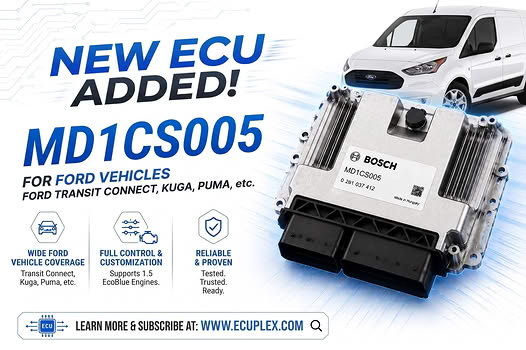
A new heavyweight just joined the ECUPlex public catalog. MD1CS005 — the Bosch ECU behind Ford's 1.5L EcoBlue diesel — is now fully supported and available to every user on a Basic, Pro, or Max subscription. For workshops that handle modern Fords on a regular basis, this is one of the most useful additions we've shipped this year.
The 1.5 EcoBlue is everywhere. It powers compact hatchbacks, crossovers, and light commercials across nearly the entire current Ford passenger lineup in Europe, and it has been doing so since 2017. That kind of installed base means a tuner working in the Ford space will run into MD1CS005 again and again — which is exactly why getting it into the catalog with full map recognition was a priority.
A closer look at MD1CS005
MD1CS005 belongs to Bosch's MD1 family — the same modern generation of engine control units you'll find across late-model Mercedes-Benz, PSA, and other European OEMs. Under the hood it runs on a Freescale/NXP MPC5777 automotive microcontroller, paired with a hardware security module (HSM) that handles cryptographic verification of the calibration. In practical terms, it's a clear generational step beyond the EDC17 era: more processing headroom, more peripherals, and significantly tighter security against unauthorized writes.
Ford has used MD1CS005 as the standard controller for the 1.5L EcoBlue (internally codenamed "Panther") since the engine's introduction in 2017. The same ECU has continued through multiple software generations, Euro 6 sub-standards, and refreshed model years — including current vehicles still rolling out of dealerships in 2025.
The 1.5L EcoBlue engine — a quick refresher
The 1.5L EcoBlue is a four-cylinder, single-turbo, common-rail diesel derived from the larger 2.0L EcoBlue platform. It shares the same architectural philosophy — aluminum ladder block construction, 10 mm crankshaft offset to reduce side-load on the piston walls, and an emphasis on lowering friction across the powertrain. Power output across the lifespan of the engine ranges from roughly 75 PS up to 120 PS, with peak torque figures typically between 185 and 300 Nm depending on the application.
Ford has tuned the engine for fuel economy and refinement rather than outright performance, which is exactly why it sells in the volumes it does — and exactly why it sees so much aftermarket attention from shops looking to unlock the headroom the factory deliberately left on the table.
Vehicle coverage
Because MD1CS005 has been the standard 1.5 EcoBlue ECU for nearly the entire production run of the engine, model coverage is exceptionally broad. Among others, you'll find it on:
- Ford Fiesta Mk7 — the first Ford to receive the 1.5 EcoBlue back in 2017
- Ford Focus IV — across hatchback, estate, and Active variants
- Ford EcoSport — facelifted models from 2018 onwards
- Ford Kuga III — diesel versions of the current-generation crossover
- Ford Puma — diesel-equipped builds
- Ford Transit Connect and Tourneo Connect — across passenger and commercial trims
- Ford Transit Courier — small van builds
If a recent Ford pulls into the bay with a 1.5 EcoBlue badge on the back, MD1CS005 is very likely the unit you'll be reading.
What ECUPlex actually does with the file
This is where it's worth being precise, because there's a lot of marketing noise in this space. ECUPlex is not a database of pre-built tuning files, and it doesn't make calibration decisions on your behalf. What ECUPlex does is take the binary you've pulled from the vehicle and automatically identify the maps inside it — labeling them, organizing them, and presenting the file in a clean, structured workspace that's ready to edit.
For MD1CS005 specifically, that means you'll land in the project with the key calibration regions already identified — injection quantity and timing maps, boost control, rail pressure, torque limiters, smoke limiters, EGR, DPF parameters, DTC tables, and the rest of the relevant structures. From that point on, the actual tuning is yours: your numbers, your strategy, your responsibility for what gets flashed back into the vehicle. ECUPlex removes the time-consuming part of finding the maps; the craft of tuning them stays exactly where it belongs.
Why it matters for your workflow
Modern Bosch MD1 controllers are unforgiving to work with manually. The data structures are denser, the maps are scattered across larger memory regions, and the file format gives up its secrets a lot more slowly than older EDC15 or EDC17 binaries. Hours spent locating and verifying maps on a single file are hours you're not billing — and on a high-volume engine like the 1.5 EcoBlue, those hours add up fast.
By taking the recognition step out of the equation, ECUPlex shortens the path from "file pulled" to "ready to tune" considerably. The cleaner your starting point, the more time you can spend on the parts of the job that actually generate value: calibration choices, validation, and the fine-tuning that separates a professional remap from a generic one.
Available now
MD1CS005 is live in the ECUPlex public catalog as of today, and is included with every Basic, Pro, and Max subscription at no additional cost. Open your dashboard, load a Ford 1.5 EcoBlue file, and see how it changes the rhythm of your workflow.
As always, feedback from real-world shop use is the fastest path to a sharper product — so if you spot something that could be better, tell us. The catalog grows the way the platform grows: one file at a time, refined by the people actually using it.