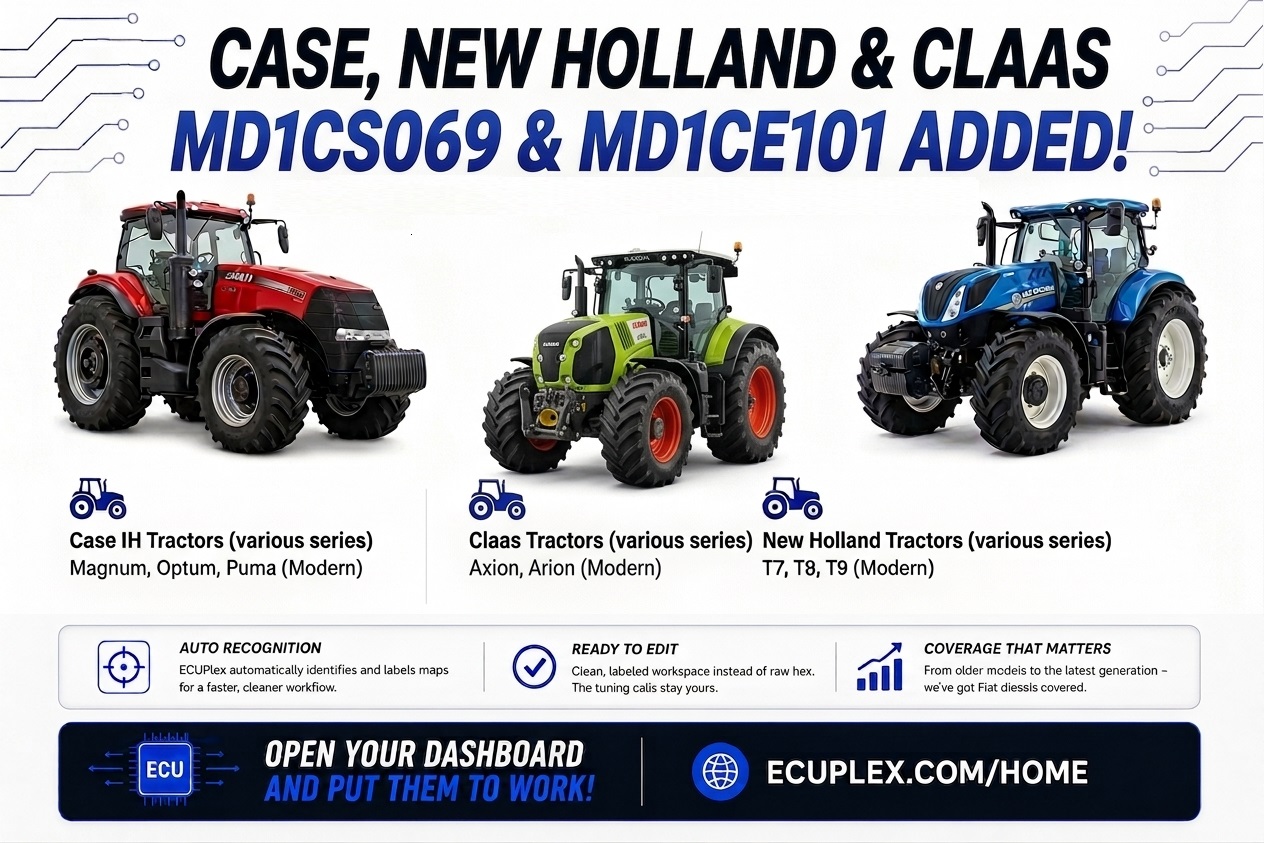
Agricultural machinery has arrived in the ECUPlex public catalog. MD1CS069 and MD1CE101 — two Bosch controllers running a substantial share of the modern New Holland, Case IH and Claas fleet — are now fully supported and available to every user on a Basic, Pro, or Max subscription.
Agricultural tuning is a segment most workshops never seriously approach. The machines are unfamiliar, the files are large, and the tooling has historically been awkward enough that it wasn't worth the learning curve for an occasional job. That's a shame, because the economics of the work are genuinely better than most of what comes through a passenger-car workshop — and the customers are far less price-sensitive than the enthusiast market.
The FPT Stage V generation
Both controllers manage FPT Industrial engines built to Euro 6d and Stage V emissions standards. This is the generation that brought the full modern aftertreatment stack — DPF, SCR, AdBlue dosing — to machinery that runs twelve-hour days in dusty fields, well away from the conditions those systems were originally validated for.
MD1CS069 is built on an Infineon TC299 microcontroller and appears across New Holland and Case IH equipment. MD1CE101 covers the larger end of the range and spans New Holland, Case IH and Claas machines. Both belong to Bosch's MD1 generation, with the processing capability and security architecture that implies.
One practical note on MD1CE101: there are two hardware revisions in circulation. Earlier units are bench-access only, while machines from roughly 2021 production onwards moved to OBD. Worth knowing before you quote a job.
Machine coverage
Between them, these two controllers reach across a broad slice of current agricultural equipment:
- New Holland T7 series tractors
- New Holland CR series combine harvesters, including the CR10.90 with the 15.9-litre straight-six
- New Holland 12.9D — 536 hp / 394 kW
- Case IH tractors and harvesting equipment across the equivalent ranges
- Claas machines running the 6.7-litre FPT engine, available in 158, 168 and 194 kW variants
Why the economics work differently here
A tractor working a thousand hours in a season burns fuel on a scale no passenger car approaches. When a factory calibration leaves torque limiters conservative — as they routinely are, for warranty and emissions-margin reasons — the cost of that conservatism compounds across every hour of every day of the harvest.
The result is a customer who thinks about the work in entirely different terms. A farm operator isn't buying bragging rights or a dyno chart to post online; they're buying a measurable reduction in fuel burn per hectare, or the ability to pull a heavier implement without dropping a gear. That calculation is straightforward to make and straightforward to justify, which makes the sale considerably easier than convincing someone that their hatchback needs another twenty horsepower.
It also tends to produce repeat business at scale. An operator with a fleet doesn't bring one machine — they bring the fleet, and then they tell the neighbouring farms. Agricultural communities are small and word travels, which cuts both ways: the work has to be right, but when it is, the referrals arrive without any marketing spend at all.
What ECUPlex actually does with the file
The same principle applies here as everywhere else on the platform. ECUPlex is not a library of pre-built tuning files, and it doesn't make calibration decisions on your behalf. What it does is take the binary you've read from the controller and automatically identify the maps inside it — labeling them, organising them, and presenting the file in a clean, structured workspace that's ready to edit.
For MD1CS069 and MD1CE101, that means landing in the project with the key calibration regions already identified — injection quantity and timing, boost pressure setpoints, rail pressure control, torque limiters, EGR strategy, DPF regeneration and SCR parameters, and DTC tables. From that point onwards, the actual calibration work is yours: your numbers, your strategy, your responsibility for what gets written back to the machine. ECUPlex removes the time-consuming part of finding the maps; the craft of tuning them stays where it belongs — with the professional doing the job.
Timing matters more here than anywhere
Harvest doesn't wait. A machine sitting in a yard during a narrow weather window isn't an inconvenience — it's a direct financial loss that grows by the hour, and the operator knows exactly what that number is. Being able to open the file, do the work, and hand the machine back the same day is worth considerably more to that customer than it would be to someone dropping off a car for the weekend.
That's the practical case for having recognition ready before the job arrives rather than working it out on the day.
Available now
MD1CS069 and MD1CE101 are live in the ECUPlex public catalog as of today, and are included with every Basic, Pro, and Max subscription at no additional cost. Open your dashboard, load a machine file, and see how it fits your workflow.
As always, feedback from real-world shop use is the fastest path to a sharper product — so if you spot something that could be better, tell us. The catalog grows the way the platform grows: one file at a time, refined by the people actually using it.