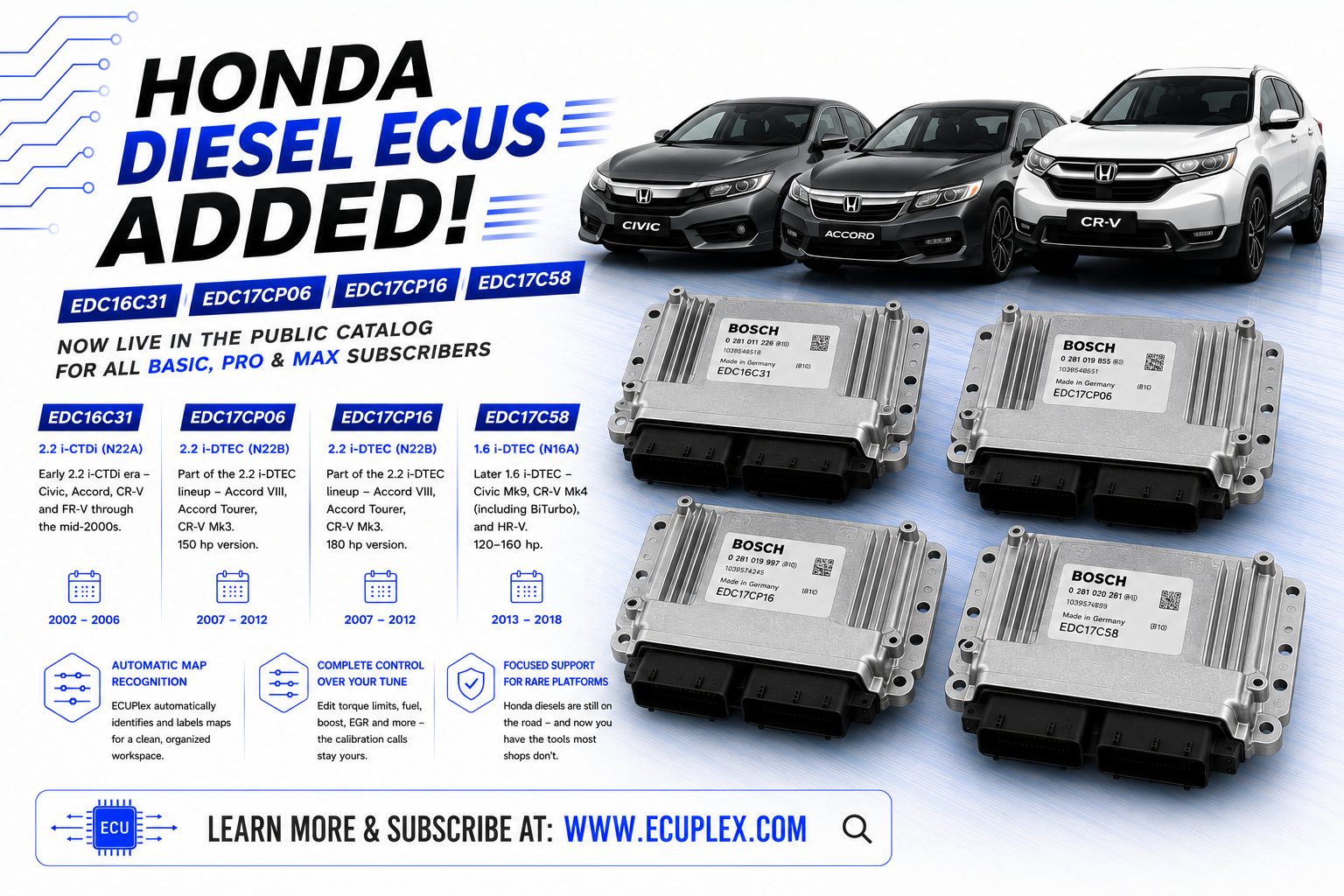
Four Bosch controllers covering the entire arc of Honda's diesel programme just landed in the ECUPlex public catalog. EDC16C31, EDC17CP06, EDC17CP16 and EDC17C58 are now fully supported and available to every user on a Basic, Pro, or Max subscription.
Honda diesels occupy an odd position in the tuning world. There are plenty of them on European roads, their owners tend to keep them a long time, and yet tool support has always been patchy enough that many shops quietly turn the work away. That's a strange gap for a market segment this size — and closing it is exactly what this drop is for.
The engine Honda built out of frustration
The N-series was Honda's first in-house automotive diesel, and its origin story is genuinely unusual. Development began in 1995 under lead engineer Kenichi Nagahiro, whose stated motivation was straightforward dissatisfaction with how clumsy the diesels of the era felt to drive. Honda leaned into that framing so hard it became the basis of the company's 2004 "Grrr" advertising campaign — hate something, change something.
The engineering backed up the marketing. The N22A used an aluminium block at a time when the segment was almost universally cast iron, ran twin overhead camshafts driven by roller chains, and paired a variable-geometry turbocharger with an intercooler. In 2005 it took International Engine of the Year in the 2.0–2.5 litre category. Honda branded it i-CTDi, and in 2008 the revised N22B arrived under the i-DTEC name.
How the four controllers line up
EDC16C31 covers the earlier 2.2 i-CTDi era — the original N22A, fitted to the Civic, Accord, CR-V and FR-V through the mid-2000s. This is the generation that established Honda as a credible diesel manufacturer in Europe.
EDC17CP06 and EDC17CP16 are best thought of as a pair. Both run the 2.2 i-DTEC (N22B) across the Accord VIII, Accord Tourer and CR-V Mk3, in outputs of 150 hp and 180 hp. Critically, the same vehicle can carry either controller depending on production date and market — which is precisely why supporting only one of them isn't much use in practice. The CP16 is built on an Infineon TC1796; both belong to the EDC17 generation with its considerably tighter security architecture compared to the EDC16 units that preceded them.
EDC17C58 handles the later 1.6 i-DTEC (N16A), produced from 2013 to 2022. This engine appeared in the Civic Mk9, the CR-V Mk4 — including the two-stage turbocharged BiTurbo version — and the HR-V. Outputs run from 120 hp in single-turbo form up to 160 hp with the twin-turbo setup, which combines a wastegate turbo and a variable-geometry unit to deliver strong torque from around 1,500 rpm.
Vehicle coverage
Between them, these four controllers cover essentially the whole of Honda's European diesel output:
- Honda Accord — 2.2 i-CTDi and 2.2 i-DTEC, saloon and Tourer
- Honda Civic — 2.2 i-CTDi, and Mk9 with the 1.6 i-DTEC
- Honda CR-V — Mk3 with the 2.2, Mk4 with the 1.6 including BiTurbo
- Honda FR-V — 2.2 diesel variants
- Honda HR-V — 1.6 i-DTEC
What ECUPlex actually does with the file
The same principle applies here as everywhere else on the platform. ECUPlex is not a library of pre-built tuning files, and it doesn't make calibration decisions on your behalf. What it does is take the binary you've pulled from the vehicle and automatically identify the maps inside it — labeling them, organising them, and presenting the file in a clean, structured workspace that's ready to edit.
For these four Honda controllers, that means landing in the project with the key calibration regions already identified — injection quantity and timing, boost pressure setpoints, rail pressure control, torque and smoke limiters, EGR strategy, DPF regeneration parameters and DTC tables. From that point onwards, the actual tuning work is yours: your numbers, your strategy, your responsibility for what gets written back to the vehicle. ECUPlex removes the time-consuming part of finding the maps; the craft of tuning them stays where it belongs — with the professional doing the job.
Why it's worth having
Honda diesels have a reputation for longevity, and that reputation is deserved — which means a very large proportion of the cars built are still in daily use. Their owners skew towards the sort of long-term keeper who invests in a car they intend to hold onto, rather than trading it in at three years.
What's been missing is consistent tool coverage. When a workshop has to turn away a CR-V because the file is awkward to work with, that customer goes elsewhere — and often takes the rest of their household's cars with them. Being the shop in your area that genuinely handles Honda diesels properly is a small but real competitive position, and it costs nothing extra to occupy it.
Available now
EDC16C31, EDC17CP06, EDC17CP16 and EDC17C58 are live in the ECUPlex public catalog as of today, and are included with every Basic, Pro, and Max subscription at no additional cost. Open your dashboard, load a Honda file, and see how it fits into your workflow.
As always, feedback from real-world shop use is the fastest path to a sharper product — so if you spot something that could be better, tell us. The catalog grows the way the platform grows: one file at a time, refined by the people actually using it.